
Introduction
If you are trying to understand what is SEO in digital marketing, you are not alone. Millions of business owners, bloggers, students, and marketers search for this topic because SEO has become one of the most important growth channels online.
Today, people use Google and other search engines for almost everything. They search for products, services, answers, reviews, and recommendations. If your website does not appear in search results, you lose traffic, leads, and sales.
That is where SEO becomes valuable.

SEO helps your website become visible when people search for topics related to your business. It increases traffic without paying for every click, builds trust, and supports long-term growth.
Whether you run an online store, service business, blog, or startup, learning SEO is a smart investment.
What is SEO in Digital Marketing?
Let us define it clearly.
SEO stands for Search Engine Optimization. It is the process of improving a website so that search engines like Google can understand it better and rank it higher in organic search results.
Organic results are unpaid listings that appear naturally based on relevance and quality.
SEO includes many activities such as:
- Keyword research
- Content creation
- Website optimization
- Improving speed
- Mobile usability
- Technical fixes
- Link building
- User experience improvements
In simple words, if someone searches for a topic related to your business, SEO helps your website appear in front of them.
For example:
If a user searches best football jerseys online, and your website ranks on page one, that traffic can become sales.
That is why understanding what is SEO in digital marketing is essential for online success.
Why SEO Matters in 2026
Digital competition grows every year. More businesses are going online, which means ranking on Google is more valuable than ever.
Why SEO is important in digital marketing:
1. Free Organic Traffic
Unlike paid ads, SEO traffic does not require payment for each click.
2. Builds Brand Trust
Users often trust websites that appear at the top of Google.
3. Long-Term Results
A strong page can generate traffic for months or years.
4. Better Leads
People searching on Google usually have clear intent.
5. Higher ROI
SEO often delivers better long-term returns than ads.
6. Competitive Advantage
Businesses with strong SEO outperform weaker competitors.
In 2026, SEO is not optional. It is a core part of digital growth.
How Search Engines Work
To fully understand what is SEO in digital marketing, you need to know how search engines operate.
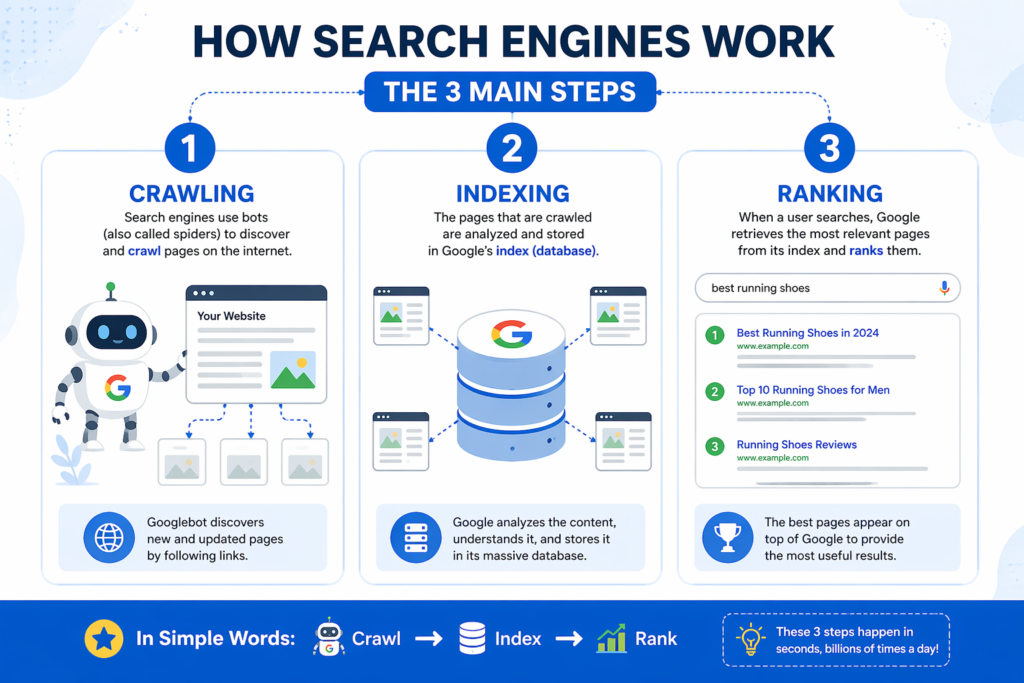
Search engines follow three main steps.
Crawling
Google uses bots to scan websites and discover pages across the internet.
Indexing
After discovering pages, Google stores and organizes content in its index.
Ranking
When users search, Google chooses which pages deserve the best positions.
Google evaluates many ranking factors, including:
- Relevance to the search query
- Content quality
- Website speed
- Mobile friendliness
- Backlinks
- Page experience
- User engagement signals
The goal is simple: show the best possible result to the user.
The Three Pillars of SEO
Every successful SEO campaign is built on three core pillars.
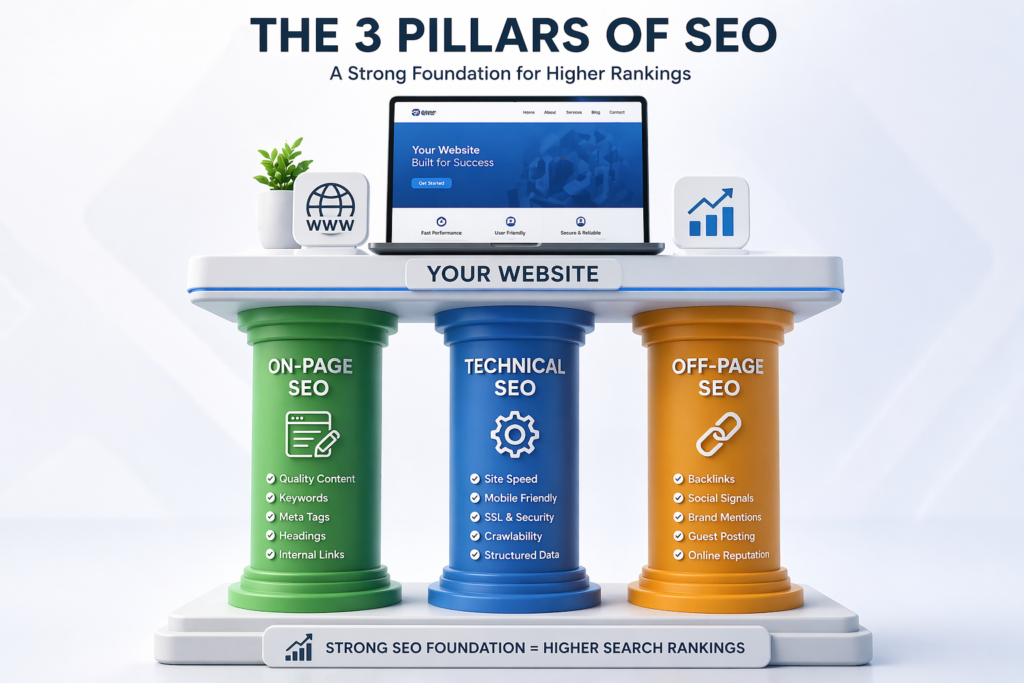
1. On-Page SEO
This includes everything you optimize on your own website.
Examples:
- Page titles
- Meta descriptions
- Headings
- Keyword placement
- Internal linking
- Image alt text
- Content quality
Good on-page SEO helps search engines understand your page.
2. Technical SEO
Technical SEO improves website performance and crawlability.
Examples:
- Fast loading speed
- Secure HTTPS connection
- Mobile responsiveness
- XML sitemaps
- Structured URLs
- Fixing broken pages
Without technical SEO, rankings can suffer.
3. Off-Page SEO
Off-page SEO builds authority outside your website.
Examples:
- Backlinks from trusted websites
- Brand mentions
- PR coverage
- Citations
- Online reputation signals
When respected websites link to you, Google sees your site as more trustworthy.
What is an SEO Strategy?
Many people know what is SEO in digital marketing, but few follow a proper strategy.
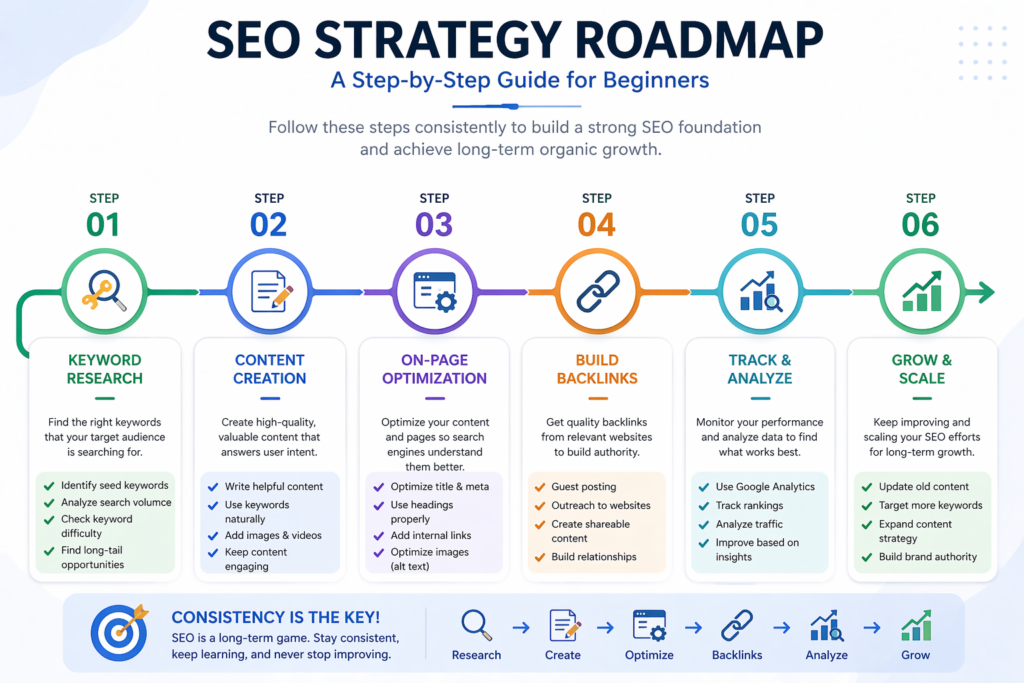
An SEO strategy is a structured plan designed to improve rankings and grow traffic consistently.
It usually includes:
- Keyword research
- Competitor analysis
- Content planning
- On-page optimization
- Technical improvements
- Backlink building
- Performance tracking
Without strategy, businesses waste time doing random tasks.
With strategy, SEO becomes measurable growth.
Benefits of SEO for Business
SEO delivers real commercial value.
Main benefits include:
| Benefit | Business Impact |
| Organic Traffic | More visitors without ad spend |
| Better Trust | Stronger brand reputation |
| Higher Conversions | Qualified leads |
| Lower Costs | Reduced dependence on ads |
| Long-Term Growth | Sustainable traffic source |
For startups and small businesses, SEO can be one of the most cost-effective marketing channels available.
SEO for Beginners Step by Step
If you are starting from zero, follow this process.
Step 1: Find Keywords
Use tools to discover what users search for.
Examples:
- Google Autocomplete
- Google Keyword Planner
- Ahrefs
- SEMrush
- Ubersuggest
Choose keywords with real search demand.
Step 2: Create Helpful Content
Focus on solving problems.
Good example:
How to Choose the Right Football Jersey Size
Better than:
Football Jersey Article
Step 3: Optimize Every Page
Use keywords naturally in:
- Title
- URL
- H1 heading
- Introduction
- Subheadings
- Meta description
Step 4: Improve Site Speed
Users leave slow websites quickly.
Step 5: Make It Mobile Friendly
Most users now browse on mobile devices.
Step 6: Build Authority
Earn backlinks through useful content, outreach, and partnerships.
Step 7: Measure Results
Track traffic and rankings using:
- Google Search Console
- Google Analytics
Then improve weak pages.
Best SEO Tools
The right tools make SEO easier.
Free SEO Tools
- Google Search Console
- Google Analytics
- Google Trends
- Keyword Planner
- PageSpeed Insights
Paid SEO Tools
- Ahrefs
- SEMrush
- Moz Pro
- Screaming Frog
Official learning resource: Google Search Central
Remember: tools support strategy, but quality content drives rankings.
Common SEO Mistakes to Avoid
Avoid these common beginner errors.
1. Keyword Stuffing
Repeating keywords unnaturally harms readability.
2. Thin Content
Short, low-value content rarely performs well.
3. Ignoring Search Intent
Your page must match what users want.
4. Slow Website Speed
Poor performance increases bounce rates.
5. No Internal Linking
Help users and search engines navigate your content.
6. Publishing and Forgetting
Update old content regularly.
7. Expecting Instant Results
SEO requires consistency and patience.
Conclusion
Now you understand what is SEO in digital marketing and why it matters in 2026.
SEO is not a shortcut or trick. It is a professional process of helping search engines understand your website and helping users find the right content.
When done properly, SEO builds traffic, trust, leads, and long-term growth.

Start with the basics:
- Research keywords
- Create useful content
- Optimize your website
- Improve user experience
- Stay consistent
That is how sustainable SEO success is built.
FAQs
What is SEO in digital marketing in simple words?
SEO means improving a website so it appears higher on Google search results.
Why is SEO important in digital marketing?
It brings free traffic, improves trust, and creates long-term growth.
What are the three pillars of SEO?
On-page SEO, technical SEO, and off-page SEO.
How long does SEO take to work?
Most websites see early results in 3 to 6 months.
Is SEO better than paid ads?
SEO is better long-term, while ads can deliver faster short-term traffic.
Can beginners learn SEO?
Yes. Beginners can start with keywords, content, and basic optimization.
Do small businesses need SEO?
Absolutely. SEO helps local and online businesses compete effectively.